Building business applications should be faster, more guided, and more practical than it is today.
For many teams, the challenge is not coming up with ideas. It is turning those ideas into usable application components, refining structure, adjusting workflows, extending logic, and getting to a workable result without slowing down delivery.
That is where Yeeflow is making AI more useful.
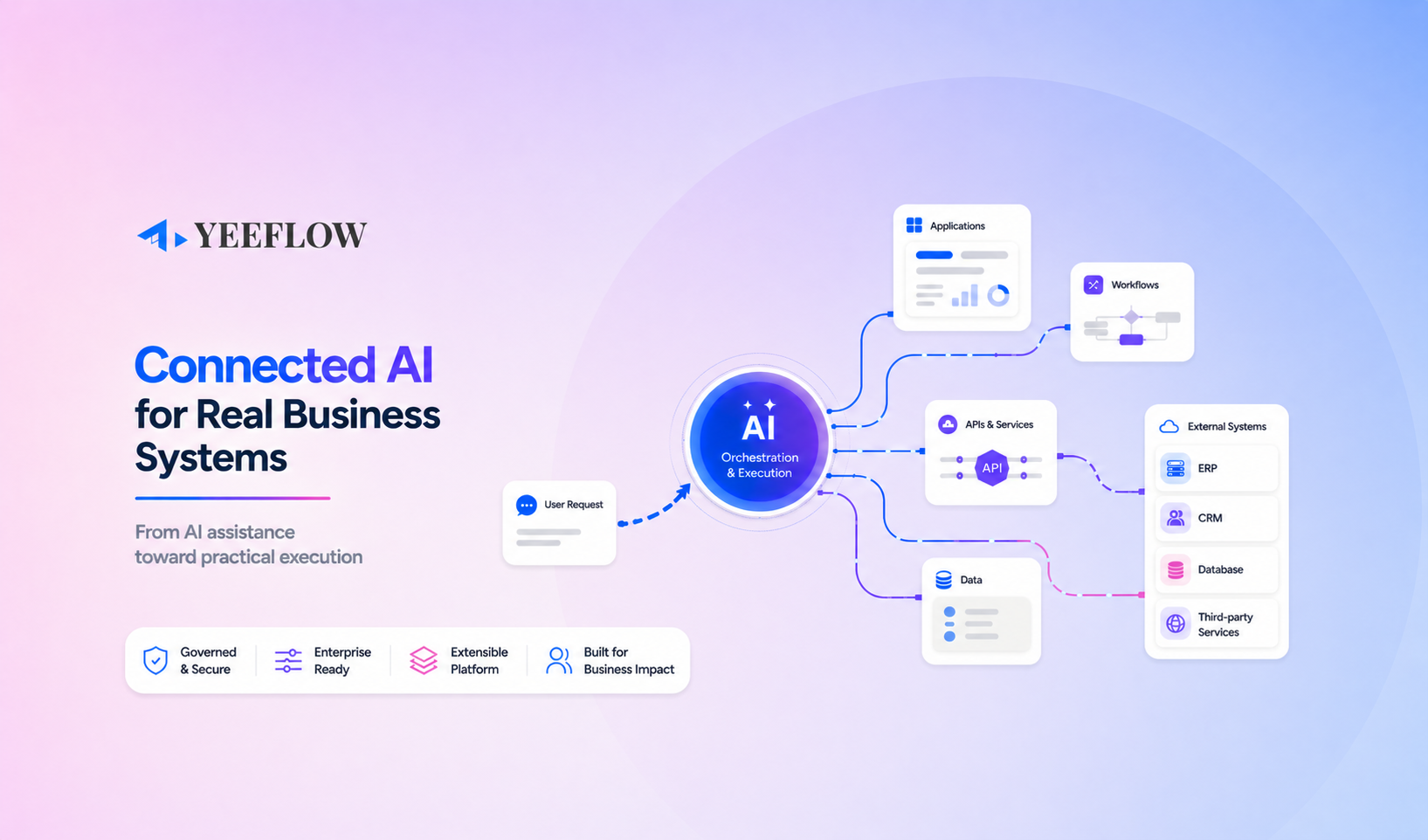
In 2026, Yeeflow is evolving into an enterprise AI application and execution platform. That means AI is not being treated as a disconnected feature or a generic chat layer. It is being built into how applications are created, used, extended, and connected to real business work.
AI Builder has to be useful for real work
There is a big difference between AI that can generate a concept and AI that can help teams build something usable.
That is why Yeeflow’s approach to AI Builder is grounded in practical creation work. The goal is not unrestricted autonomous application generation. The goal is to help builders move faster through guided creation, iterative refinement, and more practical support across real application-building tasks.
This is the right maturity path for enterprise teams.
Builders still need structure, review, control, and extensibility. AI becomes valuable when it helps reduce effort across those steps without removing the builder from the process.
What Yeeflow has already improved in 2026
Across the January, February, and April releases, Yeeflow has already made clear progress in builder productivity and practical AI-assisted creation.
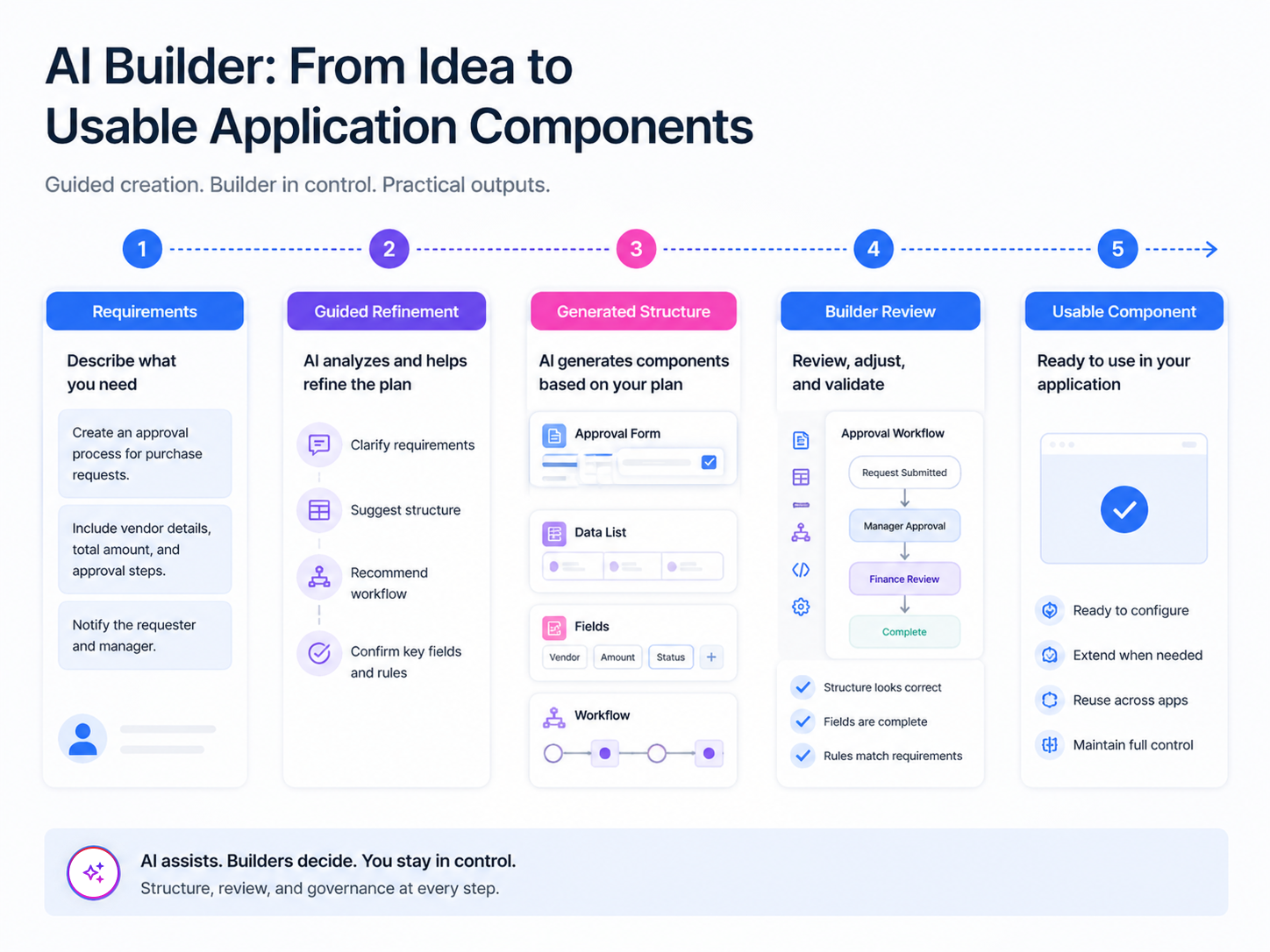
Yeeflow expanded AI Builder to support:
- generating approval forms with workflow
- generating data lists
- creating fields for existing data lists
- planning and multi-turn refinement before creation
These improvements matter because they move AI Builder beyond one-step generation and closer to real application creation work.
Instead of forcing builders into a one-prompt workflow, Yeeflow supports a more guided process. Builders can shape requirements, refine the output, and create more usable components before moving forward.
Yeeflow also improved the form and workflow designer experience, making core app-building surfaces smoother and more efficient to work with. In addition, AI Credits and AI Usage visibility gives teams a clearer view of how AI is being used across Builder, Agent, and Copilot.
In April, Yeeflow added another important layer through AI-assisted coding for custom code controls and custom code actions in forms. This gives builders a stronger way to extend applications when standard configuration is not enough.
Together, these improvements show a clear direction: Yeeflow is making AI more useful in the actual work of building applications.

What this means for builders
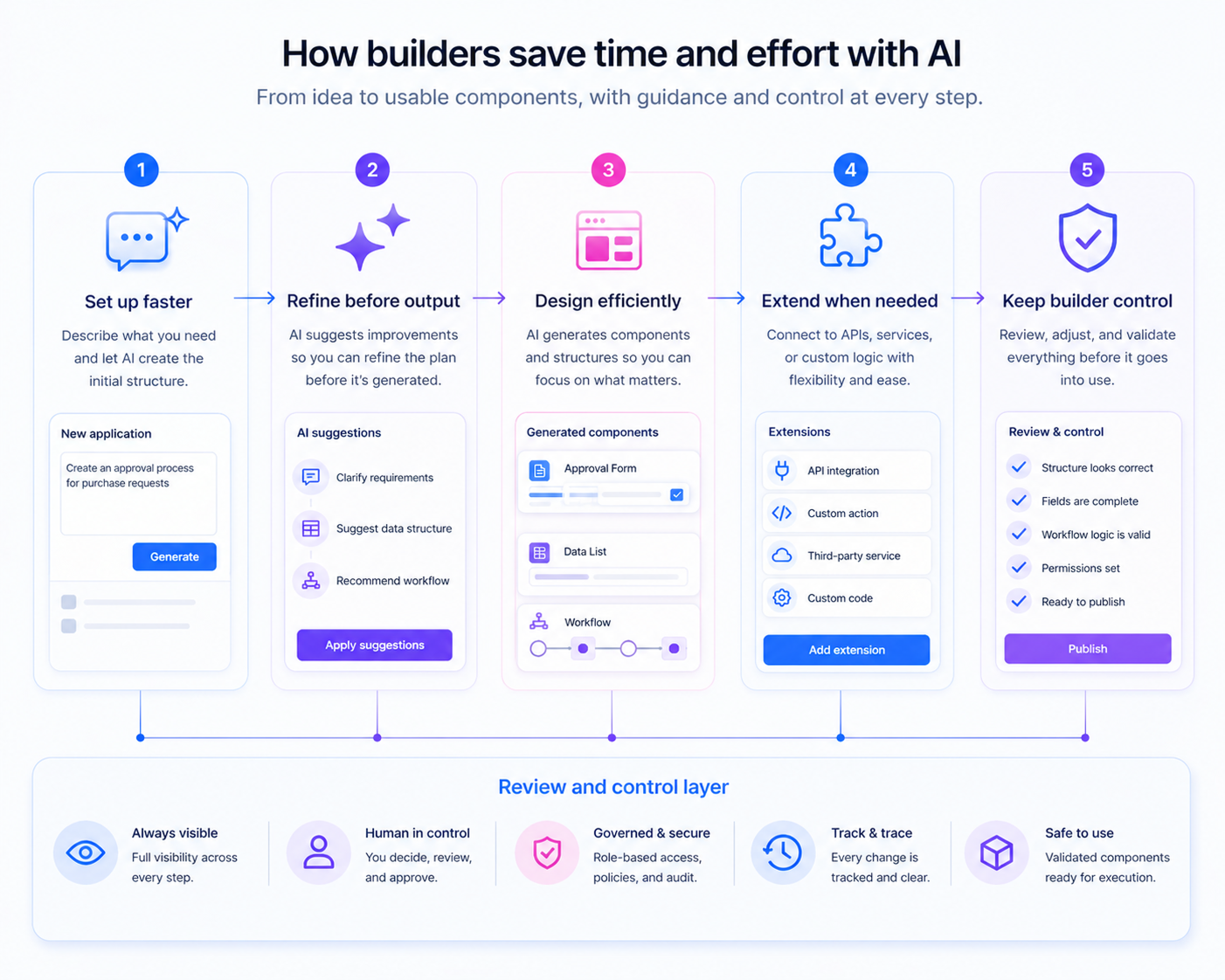
Faster setup of structured components
With AI Builder support for approval forms, data lists, and field generation, teams can get to a first usable structure more quickly. That reduces time spent on repetitive setup work and helps builders move faster into refinement and rollout.
Better guided creation before output
The planning and multi-turn refinement flow matters because enterprise application work rarely starts with a perfect prompt. Builders usually need to shape requirements before creating a usable result. Yeeflow’s guided approach makes AI more practical for that reality.
More practical day-to-day productivity
Usability improvements in form and workflow designers directly improve builder efficiency in Yeeflow’s core creation surfaces. This matters because application-building productivity is shaped not only by AI generation, but also by the quality of the everyday design experience.
More flexibility when standard configuration is not enough
AI-assisted coding helps bridge no-code speed with more advanced extensibility. When builders need custom behavior or more tailored logic, they have a stronger path to extend the application without leaving the platform workflow.
What this means for business users
This story is not only about builders. It is also about how AI becomes more useful inside the application experience itself.
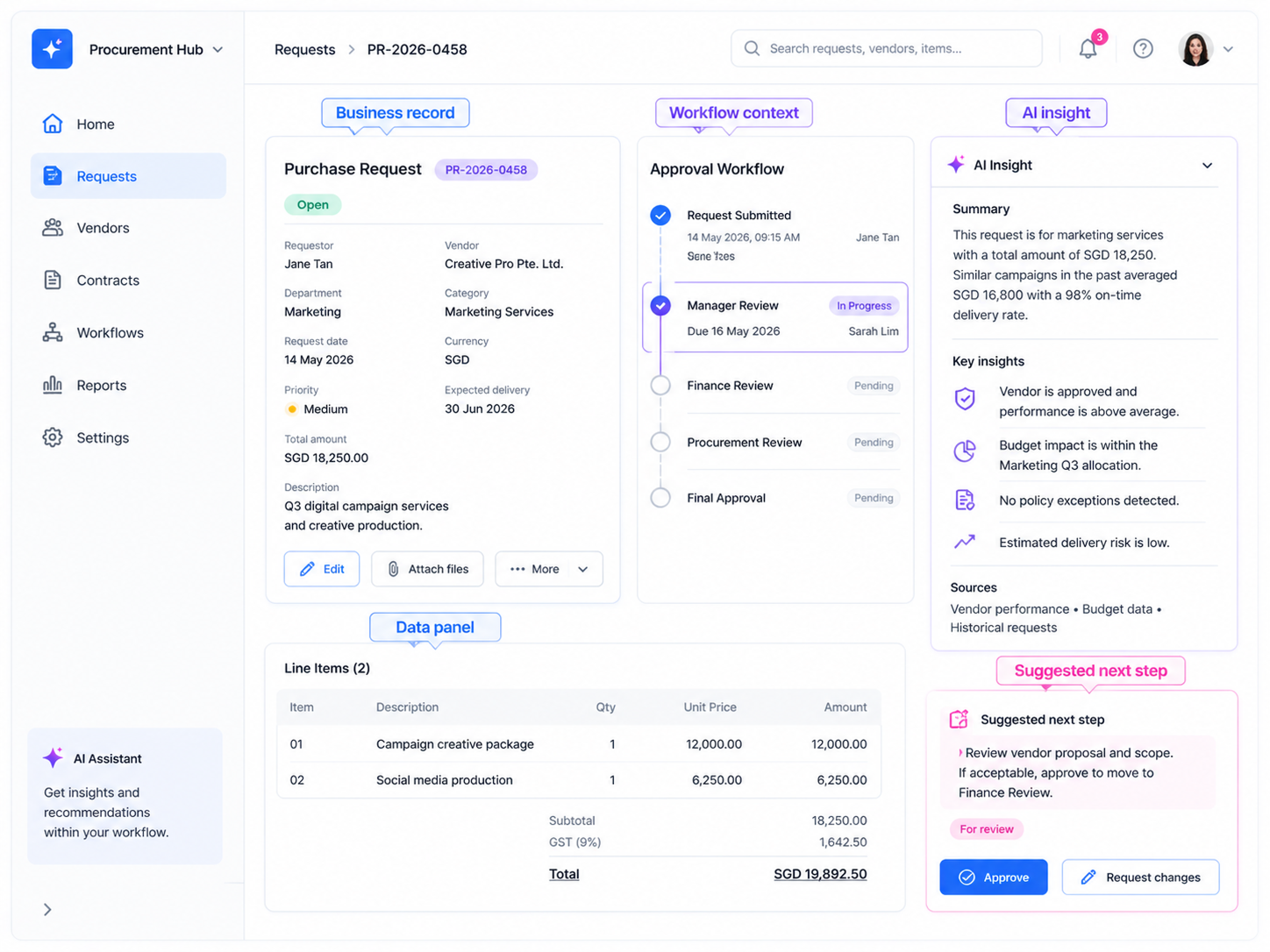
Yeeflow’s 2026 direction includes AI-powered use as a core platform layer. That means AI should help users work inside applications, data, dashboards, and reports through contextual, practical experiences rather than through a separate chatbot model.
When builders can create and refine applications faster, business users benefit from better-structured systems, more usable workflows, and stronger in-app AI support.
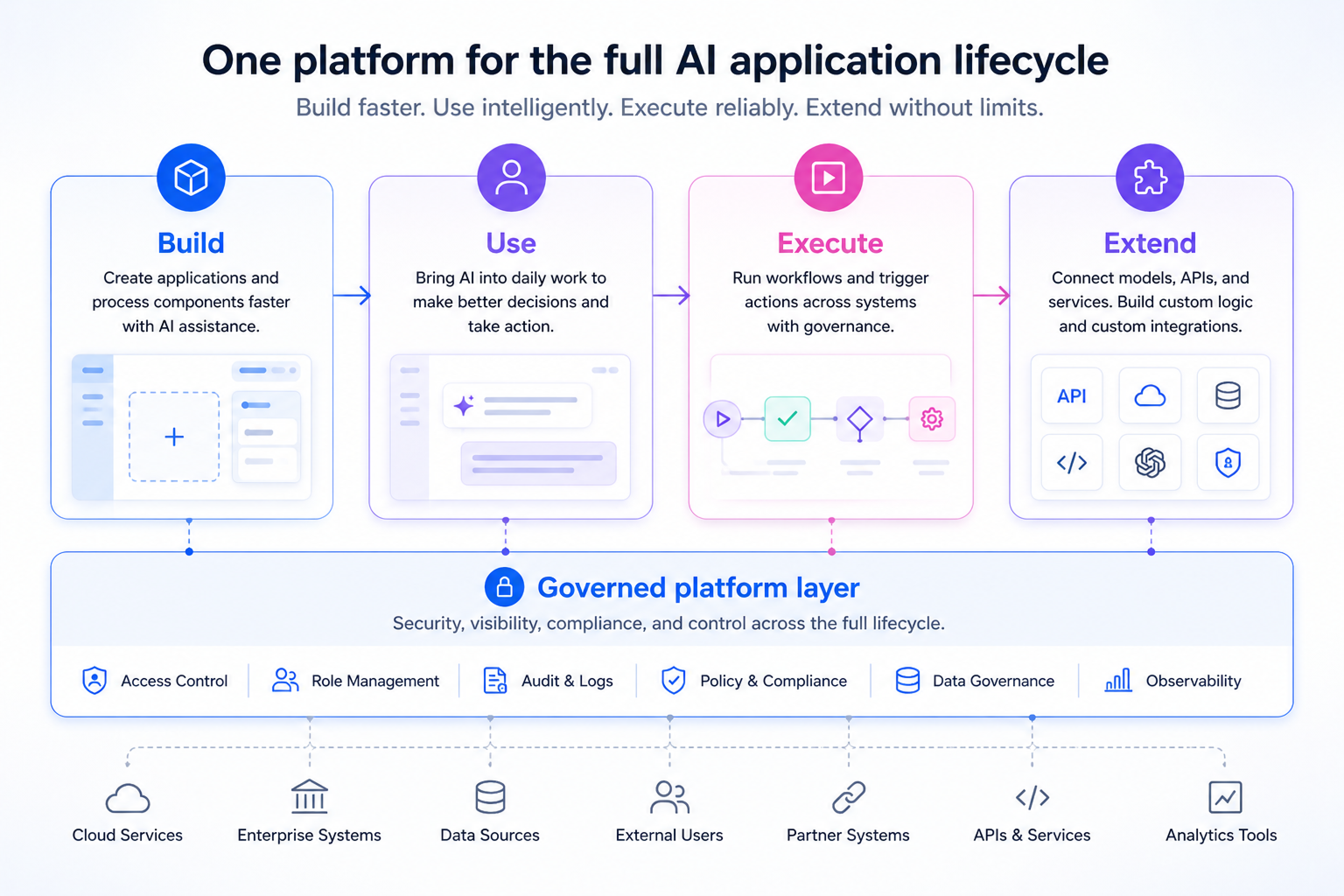
This is one reason Yeeflow’s platform direction is stronger than a simple “builder plus chatbot” story. Yeeflow is connecting AI-powered build, AI-powered use, AI-powered execution, and platform extensibility into one enterprise platform model.
Why this matters now
Enterprise AI is moving beyond isolated assistants. Teams need AI that can support the full application lifecycle — helping them build faster, use intelligence inside daily work, execute actions across workflows and systems, and extend applications through APIs, services, models, and custom logic.
That is the direction Yeeflow is moving toward in 2026: one governed AI application and execution platform where AI works inside real business processes, not outside them. With a governed platform layer across access control, roles, audit logs, policy, data governance, and observability, Yeeflow helps organizations adopt AI with both speed and control.
A practical and credible path for enterprise AI
Yeeflow’s current positioning is grounded in what enterprises need today: practical AI assistance, builder control, and governed execution.
AI can help generate structure, support guided creation, extend applications with services and APIs, and provide operational visibility. But builders still review, adjust, approve, and control what goes live. Yeeflow does not position AI as unrestricted autonomy or unsupervised decision-making. Instead, it keeps AI connected to business data, workflows, governance, and human oversight.
The message is simple:
Yeeflow helps teams build and operate business applications faster with AI — while keeping people in control, governance in place, and business value in focus.

Final thought
AI becomes more valuable when it helps people build and use real systems more effectively.
That is what Yeeflow is improving in 2026.
With guided AI Builder flows, stronger builder usability, AI-assisted component and field creation, AI usage visibility, and AI-assisted coding for extensibility, Yeeflow is making AI more practical for real application creation work.
And that is part of a larger direction: building Yeeflow into an enterprise AI application and execution platform where builders create faster, users work more naturally, and AI becomes part of real operational systems.
Read the article or book a demo to see how Yeeflow helps teams build faster with AI.